
A couple of weeks ago, we looked at how we seem to be going from Anthropocene to Symbiocene, when “human technologies take their cues from living systems and work in partnership rather than through dominance”.
The piece these extracts were from looked at the example of how, in solarpunk cities of the future, tech follows nature’s lead.
It is a truly remarkable piece, giving us a potted history of eco-urban design through the prism of the solar punk ethos. For example:
One early and unusually concrete voice was the urban designer Richard Register, who laid out, in words and drawings, what a solarpunk-like future could look like in his book Ecocity Berkeley: Building Cities for a Healthy Future (1987). His basic claim was that car-centred cities could be redesigned as ecocities. He challenged the defaults of modern planning while treating the city as an ecosystem of bodies and behaviours, not just roads and buildings. In that spirit, ecologically minded architects (sometimes calling themselves ‘ecotects’) and futurists rallied around the concept…
And there are several visualisations of what could be possible:
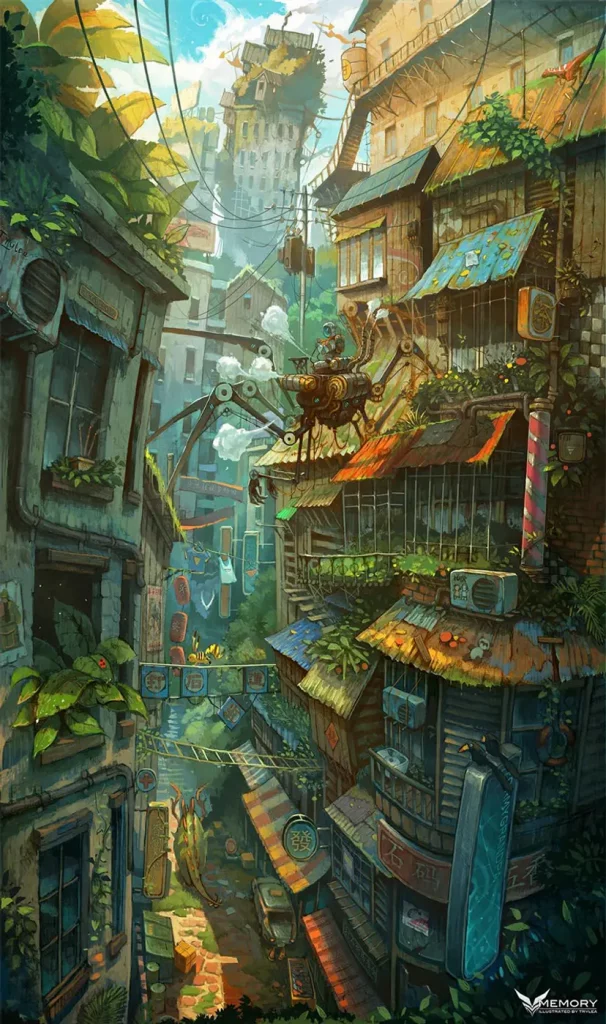
A lush vertical neighbourhood where cables, roofs and balconies double as gardens – an improvised, nature-threaded cityscape. Note this rendering of solarpunk comes with a dinosaur in the streets (de-extinction) and a flying, steam-powered insect vehicle; digital illustration by the Chinese artist Trylea (aka Zhichao Cai). Courtesy Zhichao Cai
The piece finishes thus:
Solarpunk welcomes an integrated view of nature and technology, treating them as intertwined rather than opposed. It imagines a cosmotechnics that acknowledges culturally and environmentally bespoke ways of making, and a biotechnics that treats design as symbiosis rather than domination. It redefines the territory of technology and nature, asking how we can use our tools to serve the living world, rather than the other way around. It promises a world based on mutual aid and solidarity, smilingly acknowledging the self-sabotage of gratuitous competition and scarcity.
This attractive future of thriving in global peace and abundance prompts the question: who is tuning into the solarpunk frequency to advance its timeline? Some might resist, but solarpunk doesn’t ask us to deny what we’re losing. It asks us to notice what is already germinating in the cracks.
…