
How useful is it to think in terms of ‘utopia’ – and even to work towards it?
Looking back at earlier posts, there should be something between the visionary and the utopian. That might even give us some pragmatic utopia.
There is a lot of utopian fiction after all, itself part of the inspiration for the solarpunk movement – and now there are utopian fiction prizes to be had.
Ultimately, though, perhaps what we really need is “utopianism for a dying planet” – author Gregory Claeys’ “brilliant setting out of why we need Utopianism now more than ever. In it he says ‘only the extraordinary can save us now’, our new mantra”.
Because, surely our biggest challenge is defying dystopian doomerism – and maybe the promise of solarpunk is to “close the plausibility gap” between our dystopian present and a non-dystopian future…
Going back to its roots, then, perhaps we can see How Solarpunk Fiction Defies Dystopian Doomerism – with a particular look at one of the defining works of the 1970s:
Far from Star Trek’s “full luxury space communism,” where humans race across galaxies via endless sources of energy, the technology in solarpunk is imminently achievable. In the anthology Future Primitive: The New Ecotopias, science fiction writer and democratic socialist Kim Stanley Robinson describes this genre as rejecting “the inevitability of the machine future.” Instead it asks, “What is the healthiest way to live? What is the most beautiful?” Rather than Elon Musk’s tent cities on Mars, these fictional worlds “cobble together aspects of the postmodern and the paleolithic, asserting that we might for very good reasons choose to live in ways that resemble in part the ways of our ancestors.”
‘Ecotopia,’ Ernest Callenbach, 1975
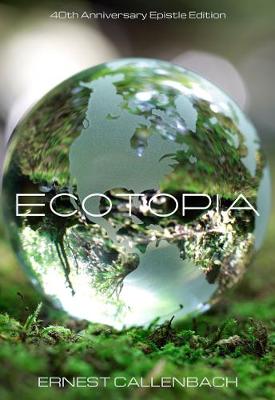
Ernest Callenbach’s 1975 environmentally conscious classic, Ecotopia, is written as a series of reported articles and journal entries by William Weston, a reporter for a New York Times-style prestige newspaper. He is the first American to be allowed into the new nation of Ecotopia, a conglomeration of states, including swathes of Northern California and the Pacific Northwest, that have seceded from the U.S. and formed a new nation.
Ecotopia incorporates several mainstays of the solarpunk genre, including a conscious selectivity in its use of technology. Where today we spend half our waking hours online, feel naked without our smartphones, and have WiFi-enabled toaster ovens, Ecotopians are mindful of advanced technology and use it with care. The citizens of Ecotopia use “video phones” and heat their homes with highly sophisticated solar technology; however, they choose to make many tools and items of clothing by hand. Their technology, although highly sophisticated, is nonaddictive and used sparingly.
Another mainstay of solarpunk is a focus on means, process, and getting by in everyday life. Large portions of the novel are devoted to explaining urban planning, sewage, waste disposal, and food production in Ecotopia. By book’s end, we know how Ecotopia functions, from plumbing to higher education. We learn about Ecotopian cradle-to-grave universal healthcare and their community-based cottage hospitals. We learn about their biodegradable plastics, worker-controlled businesses, and 20-hour workweeks…
In Future Primitive, Kim Stanley Robinson calls Ecotopia, “one of the most important and influential utopias of the 20th century, using a wide range of environmental concepts to design a very near-future society carved out of America.” Rather than being made from whole cloth, Ecotopia finds its key ingredients in America. It isn’t a fantasy: we have the tools right now, we just need to use them correctly. Ecotopia is not as polished and literary as many of the other books I’ll list here. Callenbach was an editor and film professor by trade and Ecotopia and its sequel, Ecotopia Emerging, are his only novels. He nevertheless had a profound influence on the literature to come. According to Robinson in Future Primitive, which was published in 1994, at the time he could still find bumper stickers in Northern California that read “Keep the U.S. Out of Ecotopia.” However imperfect and of its time Callenbach’s ’70s-era solar utopia, it is impressively thoroughgoing. It is utopian literature in its purest sense: a philosophical teaching tool that eschews literary subtlety for blunt force pedagogy.
…